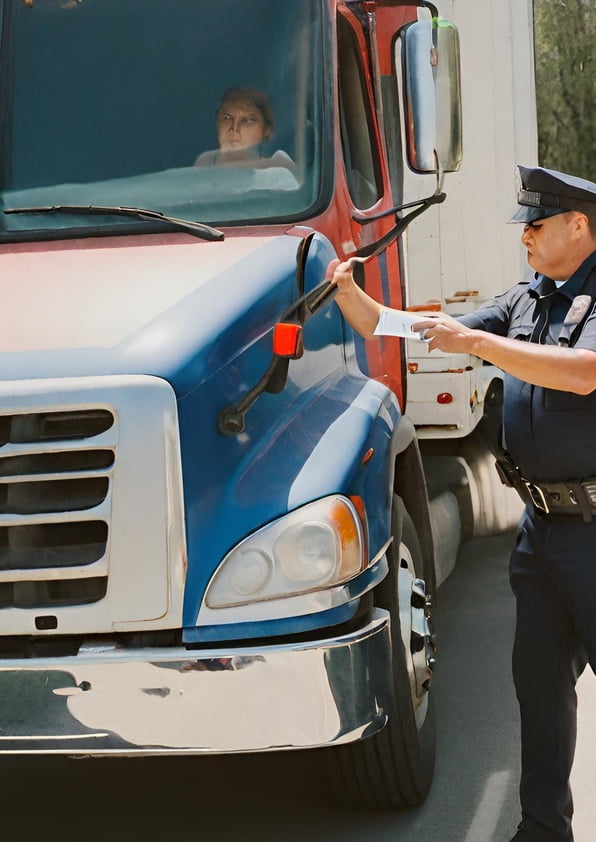
The FMCSA has issued a Regional Emergency Declaration granting temporary Hours of Service (HOS) relief due to severe winter storms and extreme cold impacting major U.S. transportation corridors. While the exemption provides regulatory relief, it does not magically make ELD compliance problems disappear.
This is where carriers and drivers get into trouble.
The federal government may exempt a driver from certain HOS limits — but the ELD still records data unless you tell it otherwise. An ELD does not understand emergency declarations, intent, weather, or common sense. It only understands inputs, rules, and thresholds.
If this exemption is not managed correctly, a driver can appear non-compliant roadside or during a compliance review, even while operating lawfully under the emergency declaration.
What the FMCSA Emergency Declaration Actually Does
Under Emergency Declaration No. 2026-001, FMCSA has granted emergency relief from:
This relief applies only to motor carriers and drivers providing direct assistance supporting emergency relief efforts in the affected states. It does not apply to routine commercial deliveries, mixed loads with nominal emergency supplies, or long-term recovery operations. All other FMCSRs remain fully in effect, including CDL, drug and alcohol testing, insurance, hazardous materials, and vehicle size and weight requirements.
The ELD Problem No One Understands
There is no regulatory interpretation guide in the U.S. or Canada that explains how ELD data should be managed. There is only:
ELD providers are not required to train carriers, drivers, or enforcement on how their applications function. They built an app. It is up to the user to figure out how to operate it correctly under real-world conditions.
And here’s the critical reality:
ELDs record data whether the driver is exempt or not.
If a driver:
None of those outcomes are what you want during an emergency exemption.
The Only Regulatory Workaround That Exists
The HOS regulations and the ELD Technical Standard do provide a workaround — the Exempt Driver function.
What the Regulation Says
49 CFR § 395.28(b) — Drivers exempt from ELD use
“A motor carrier may configure an ELD to designate a driver as exempt from ELD use.”
What the Technical Standard Says
49 CFR Part 395, Appendix A, Subpart B, Section 3.1.3 — Exempt Driver
“An ELD must allow a motor carrier to configure an ELD for a driver who may be exempt from the use of the ELD… motor carriers can use this allowed configuration to avoid issues with unidentified driver data diagnostic errors.”
There is a clear acknowledgement here that functionality issues exist, and the exempt driver configuration is the mechanism provided to deal with them.
Further clarified in:
Section 4.3.3.1.2(a)
“An ELD must provide the motor carrier the ability to configure a driver account exempt from use of an ELD.”
How the Exempt Driver Function Actually Works
The technical standard does not require a carrier to use the exemption — only that the ELD provider make it available. The decision to activate it rests entirely with the carrier.
Carrier Setup
Driver Operation
Important limitations:
What the ELD Does While the Driver Is Exempt
49 CFR Part 395, Appendix A, Section 4.3.3.1.2(d)(2) states:
“The ELD must continue to record ELD driving time but suspend detection of missing data elements data diagnostic events and data transfer compliance monitoring functions when such driver is authenticated.”
On the device:
This distinction matters.
Roadside Inspections and Audits: How to Defend It
During a roadside inspection, the driver should state:
“I am operating under FMCSA Emergency Declaration No. 2026-001 and am exempt from HOS limits.”
The driver must then:
Do not assume enforcement has read the bulletin email.
During a compliance review or audit:
Bottom Line
Using the emergency exemption properly is cumbersome, but the exempt driver function is the only way to keep ELD records aligned with both the regulation and the technical standard.
This is not about convenience — it’s about defensibility.
Drivers need to be able to explain it roadside.
Administrators need to be able to explain it during a review.
Enforcement and auditors are not trained in ELD minutiae. If you follow the exact mechanisms provided in the regulation and technical standard, you are using their own language, systems, and rules to protect yourself — and to successfully challenge incorrect findings if necessary.